Saju Relationships
Saju Compatibility: How Two Charts Actually Match (and What 'Incompatible' Really Means)
SajuClarity Editorial · June 22, 2026
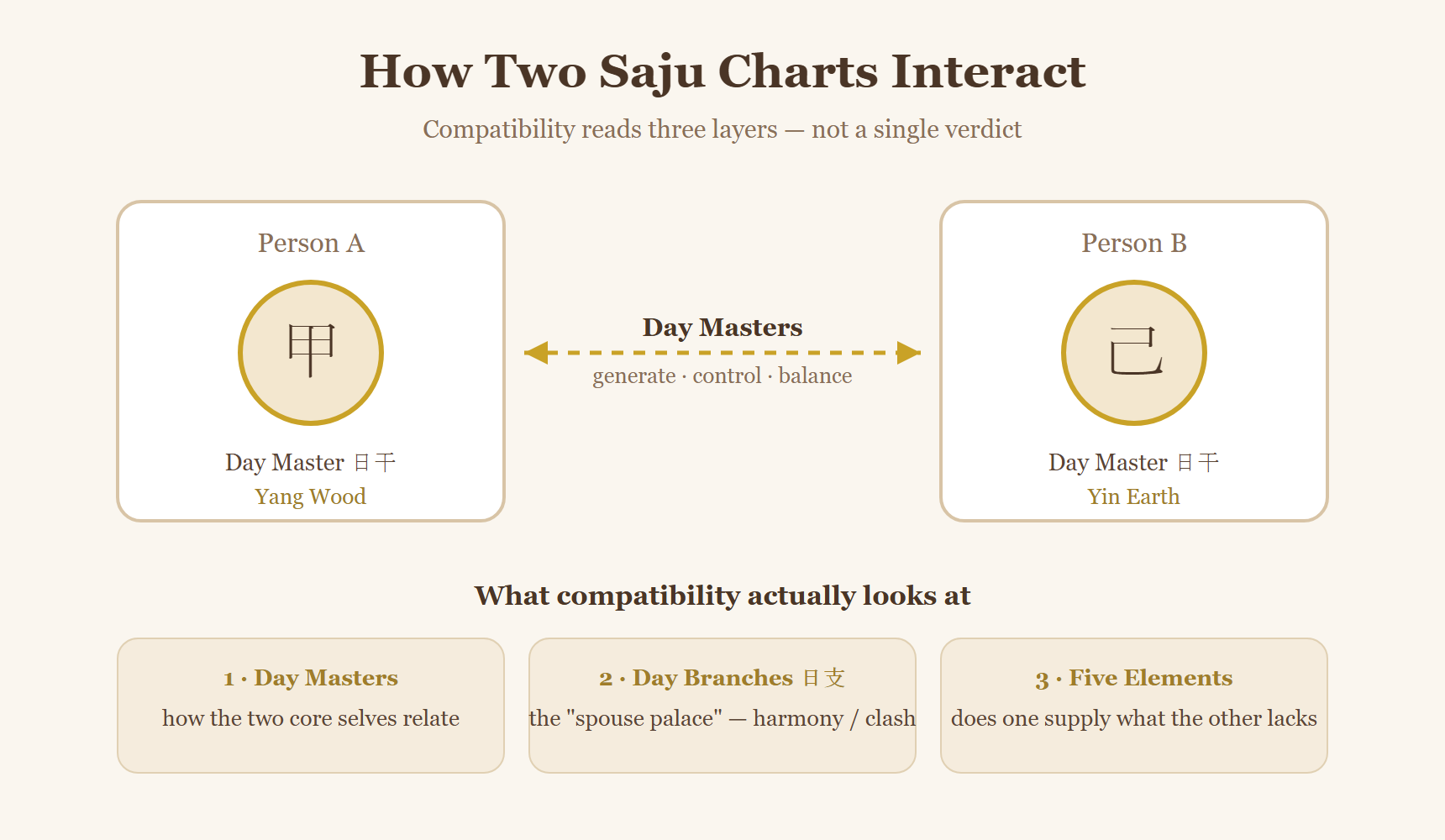
So you've met someone, and a small voice is asking: are we actually a good match? In Saju (사주), the Korean reading of the Four Pillars of Destiny, compatibility isn't decided by a single love score or a yes/no stamp. Saju determines compatibility by comparing two people's birth charts — looking at how their core selves (called the Day Master) interact, how the animal signs in their charts harmonize or clash, and whether one person's Five Elements supply what the other is missing. It reads two energy patterns side by side and asks where they flow together and where they grind.
That's the honest version. Compatibility in Saju is a map of tendencies, not a sentence handed down by fate. Let's walk through how it actually works.
First, a Quick Refresher on the Chart
Every Saju chart is built from four pillars — year, month, day, and hour of birth. Each pillar has two parts stacked together: a Heavenly Stem (天干) on top and an Earthly Branch (地支) below. That's eight characters total, which is why the same system is called BaZi (八字), literally "eight characters," in Chinese practice.
The single most important character for you personally is the Day Master (日干) — the Heavenly Stem of your Day Pillar. It represents your core self. There are ten possible Day Masters, each one a Five Element in a yang or yin form: Yang Wood (甲) and Yin Wood (乙), Yang Fire (丙) and Yin Fire (丁), Yang Earth (戊) and Yin Earth (己), Yang Metal (庚) and Yin Metal (辛), and Yang Water (壬) and Yin Water (癸).
The twelve Earthly Branches are the familiar zodiac animals, and each carries an element too — for example the Rat (子) is Water, the Tiger (寅) is Wood, the Horse (午) is Fire, and the Monkey (申) is Metal. These branches do a lot of the relational heavy lifting.
If you haven't seen your own eight characters yet, it's worth a look before reading further:
Curious what your own eight characters say? Map your Four Pillars free at SajuClarity
Pillar One of Compatibility: How the Two Day Masters Relate
The first thing a Saju reader compares is the two Day Masters — your core element against your partner's. This is the heart of day master compatibility, and it usually falls into one of three relationships drawn from the Five Element cycle.
Generating (생, the productive cycle). One element feeds the other: Water nourishes Wood, Wood fuels Fire, Fire makes Earth, Earth bears Metal, Metal carries Water. When one person's Day Master generates the other's, there's often a natural giving-and-receiving dynamic — one tends to support and energize, the other to receive and grow. Warm, but worth noticing who's usually doing the pouring.
Controlling (극, the regulating cycle). One element restrains the other: Wood parts Earth, Earth dams Water, Water quells Fire, Fire melts Metal, Metal cuts Wood. A controlling relationship isn't "bad" — it can mean one partner keeps the other grounded and focused. But under stress it can tip into feeling managed or held back, so it asks for conscious balance.
Same element. Two Wood Day Masters, say, often understand each other instantly — similar instincts, similar pace. The flip side is that they may share the same blind spots and compete for the same space rather than complementing each other.
Notice that none of these is a winner. A "controlling" pairing between two self-aware people can be steadier than a "generating" pairing where one quietly burns out. The cycle describes the current between you, not your worth as a couple.
Pillar Two: Earthly Branch Harmony and Clash
Beneath the stems, the Earthly Branches form their own relationships, and this is where Saju gets specific. Certain animal signs naturally combine, and certain ones clash.
Combinations (합). Some branches form harmonious pairs and trios that pull energy together — think of them as signs that instinctively cooperate. When two charts share these combinations, the relationship tends to feel cohesive and mutually reinforcing.
Clashes (충). Other branches sit directly opposite each other and create friction — the Rat and Horse, or the Tiger and Monkey, for instance. A clash isn't a curse. It's a high-voltage line: lots of energy, lots of attraction sometimes, but also more sparks to manage. Many vibrant, long-lasting couples have clashes in their charts and simply learn the rhythm of them.
The Spouse Palace
There's one branch that matters most for love: the Day Branch (日支), traditionally called the spouse palace. Because the Day Pillar is your pillar, the branch sitting under your Day Master is read as the seat of your closest partnership.
When two people's Day Branches form a harmonious combination, it often signals an easy domestic fit — you "get" how the other person lives. When the Day Branches clash, it points to friction in the most intimate, everyday space: not doom, but a spot to bring extra patience and clear communication. Saju is pointing at where to pay attention, not telling you to walk away.
Pillar Three: Do You Complete Each Other's Elements?
The third lens is the most quietly powerful: complementary Five Elements balance. Most charts lean heavy in some elements and run short in others. Someone might be rich in Fire and Wood but almost empty of Water and Metal.
Compatibility asks: does your partner's chart supply the elements yours is missing? If your chart craves Water and theirs is full of it, their presence can feel stabilizing and nourishing in a way that's hard to put into words. This is the real engine behind a lot of korean love compatibility readings — two charts that, combined, form a more complete and balanced whole than either does alone.
This is also why people who look "different" on paper often pair beautifully. Saju doesn't reward sameness; it rewards balance.
So What Does "Incompatible" Actually Mean?
Here's the part worth saying plainly. In Saju, "incompatible" is never a verdict — it's a list of friction points to understand. A chart comparison that shows a Day Master control dynamic, a Day Branch clash, and overlapping elemental gaps isn't telling you the relationship is doomed. It's telling you exactly where the work will be: maybe around control and autonomy, maybe around daily-life rhythms, maybe around feeling energetically drained in the same areas.
That's incredibly useful information. A couple who knows their friction sits in the spouse palace can be deliberate about protecting their home life. A couple who shares an elemental gap can consciously build that missing element into their life together through environment, habits, and even timing.
No chart pairing guarantees happiness, and no chart pairing guarantees failure. Saju gives you the terrain, not the destination. Two committed people who understand their map will outperform a "perfect match" who takes the relationship for granted every time.
A Few Honest Cautions
Compatibility is one layer of a chart, not the whole story. A full reading also weighs each person's overall balance, their luck cycles, and how their charts evolve over time. Treat a compatibility reading as a conversation starter and a self-awareness tool — a guide, not a gatekeeper. The most reliable predictor of a relationship's future is still how two people choose to show up for it.
Frequently Asked Questions
Can two people be "perfectly compatible" in Saju?
Not in an absolute sense. Saju looks for balance and complementarity, not perfection. A pairing might harmonize beautifully in their Day Masters yet have a spouse-palace clash to navigate. Strong compatibility means the strengths clearly outweigh the friction points — and that both people understand where to put their care.
Do we need our exact birth times for a compatibility reading?
Birth time sharpens the picture because it sets your Hour Pillar, but the Day Pillar — your Day Master and your spouse palace — comes from your birth date. So a meaningful comparison is possible from dates alone, and an exact time simply adds depth and precision.
If our charts "clash," should we break up?
No. A clash points to an area that runs hot — somewhere you'll feel more friction and need more intention. Plenty of lasting, loving couples have clashes in their charts. Saju is showing you where to grow together, not handing down a verdict on your future.
See It in Your Own Charts
The clearest way to understand compatibility is to start with your own eight characters — your Day Master, your spouse palace, and your elemental balance — and then see how someone else's pattern meets yours.
Start with your own Four Pillars chart, free and instant, at SajuClarity
See it in your own chart
Start free — build your Saju chart in seconds. Ready for the full picture? The complete 15-chapter reading interprets all of it: who you are, how you love and work, and the years ahead.