Saju Basics
How to Read Your Saju Chart: A Beginner's Step-by-Step Guide
SajuClarity Editorial · June 22, 2026
So you have a Saju chart in front of you — a neat little grid of unfamiliar characters — and you have no idea where to start. You're in the right place.
To read a Saju chart, you work through four steps in order: (1) find your Day Master (日干) — the stem that represents your core self; (2) read the four pillars of Year, Month, Day, and Hour; (3) check which of the Five Elements are abundant or missing; and (4) look at how the elements interact. Saju (사주, "four pillars") is a Korean reading of your birth chart, known in Chinese as BaZi (八字), meaning "eight characters." Once you understand that structure, the grid stops looking like code and starts telling a story about your temperament and tendencies.
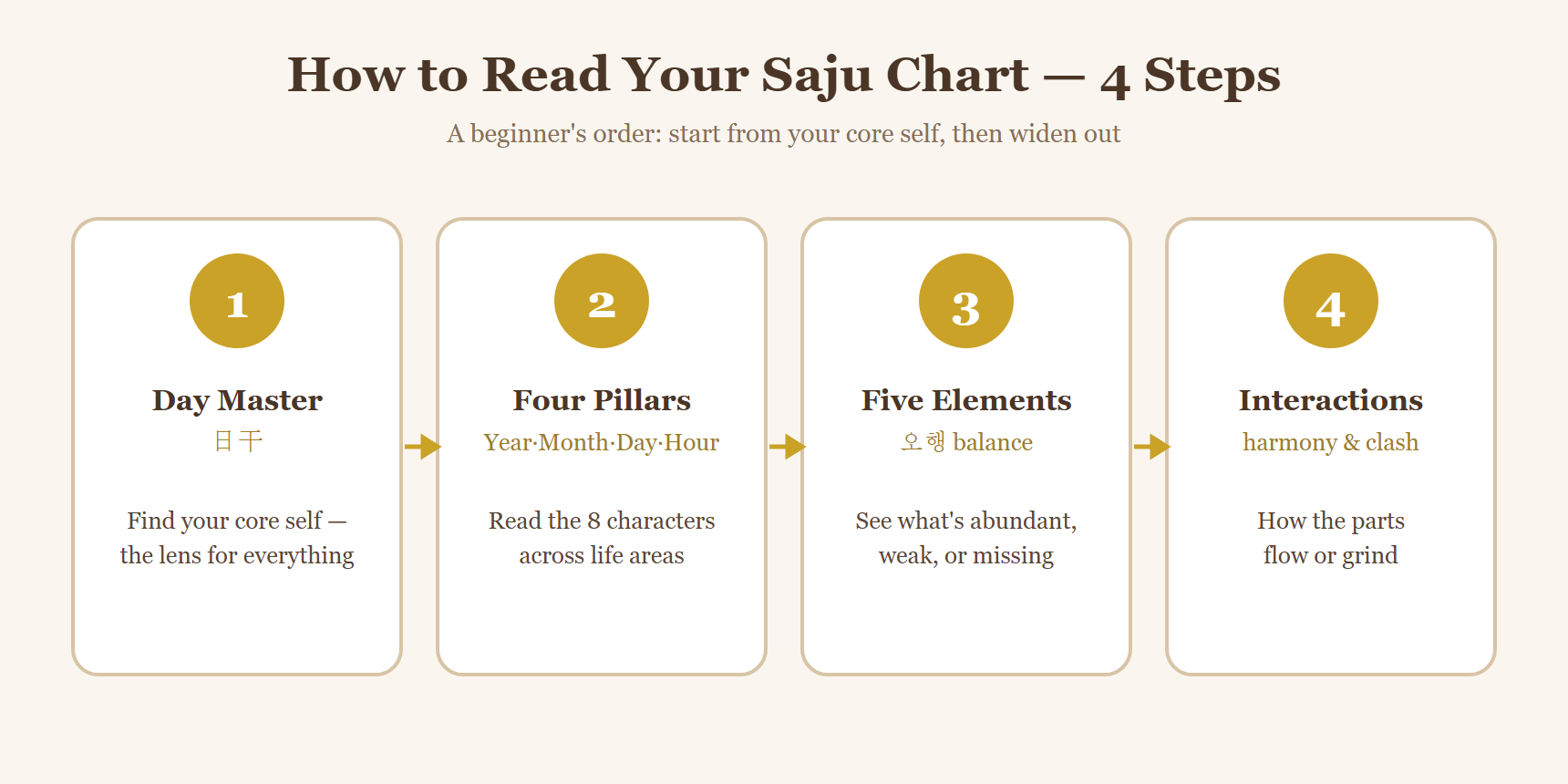
Let's walk through it slowly.
First, What Is a Saju Chart Made Of?
A Saju chart has four pillars (四柱) — one each for the year, month, day, and hour of your birth. Each pillar is a stacked pair: a Heavenly Stem (天干) sitting on top, and an Earthly Branch (地支) underneath.
Four pillars × two characters each = eight characters total. That is exactly why BaZi means "eight characters." Every reading you'll ever do begins with these eight.
The stems and branches aren't random symbols. Each one carries an element and a polarity (Yang or Yin), and that's where the meaning lives.
Step 1: Find Your Day Master
Look at the Day Pillar — the third pillar from the left in most layouts. The stem on top of it is your Day Master (日干), sometimes called the Day Stem. This is you: your core self, the reference point for the entire chart.
Here's the key idea — everything in Saju is read relative to your Day Master. Other elements aren't "good" or "bad" on their own; they matter in relation to who you are at the center.
Your Day Master will be one of the ten Heavenly Stems, which are simply the Five Elements expressed in Yang and Yin forms:
- 甲 Yang Wood, 乙 Yin Wood
- 丙 Yang Fire, 丁 Yin Fire
- 戊 Yang Earth, 己 Yin Earth
- 庚 Yang Metal, 辛 Yin Metal
- 壬 Yang Water, 癸 Yin Water
A quick example of tendency, not destiny: a 甲 Yang Wood Day Master is often described like a tall tree — upright, growth-oriented, a bit stubborn. A 乙 Yin Wood person is more like a vine or flower — flexible, adaptive, good at working around obstacles. Same element, different expression. Neither is better.
Knowing your element is the single most useful thing a beginner can do, so it's worth getting your exact chart before going further.
Generate your own Four Pillars chart — free at SajuClarity
Step 2: Read the Four Pillars
Now zoom out and read all four pillars together. Each one loosely governs a life area and a stage of life:
- Year Pillar — ancestry, family roots, your early environment.
- Month Pillar — parents, upbringing, and often career and social standing.
- Day Pillar — yourself (the stem) and your spouse or closest partnership (the branch).
- Hour Pillar — children, your later years, and how things wind down.
Read them left to right as a timeline of sorts: roots, formative years, adult self, later life. This isn't a fixed prophecy — it's a map of where certain themes tend to show up in your life.
While you're here, note the twelve Earthly Branches sitting under each stem. These are the familiar zodiac animals, each tied to an element:
子 Rat (Water), 丑 Ox (Earth), 寅 Tiger (Wood), 卯 Rabbit (Wood), 辰 Dragon (Earth), 巳 Snake (Fire), 午 Horse (Fire), 未 Goat (Earth), 申 Monkey (Metal), 酉 Rooster (Metal), 戌 Dog (Earth), 亥 Pig (Water).
If you were "born in the year of the Horse," that's your Year Branch — but it's only one of eight characters, which is why Saju is far richer than a single zodiac sign.
Step 3: Check the Five Elements Balance
This is where a chart really opens up. Take all eight characters and sort them by element: Wood, Fire, Earth, Metal, Water. Count how many of each you have.
You're looking for two things:
- Which elements are abundant — these show natural strengths and where your energy flows easily.
- Which elements are scarce or missing — these often point to areas you have to work at consciously, or qualities you're drawn to in others.
For example, someone with lots of Fire and very little Water might be passionate and expressive but benefit from cultivating calm and reflection. Again — a tendency to balance, not a flaw to fear.
The balance is always read through your Day Master from Step 1. An element that overwhelms a delicate Yin Day Master plays out very differently than the same element supporting a strong Yang one. That relationship — self versus surrounding elements — is the heart of interpretation.
Step 4: Look at the Interactions
The final step is the most nuanced, and the one beginners can take lightly at first. The elements don't sit still; they interact.
In classical Five Elements theory, there are two basic cycles:
- Generating (生) — each element feeds the next: Wood feeds Fire, Fire makes Earth (ash), Earth bears Metal, Metal collects Water, Water grows Wood.
- Controlling (剋) — each element restrains another: Wood breaks Earth, Earth dams Water, Water quenches Fire, Fire melts Metal, Metal cuts Wood.
When you read a chart, notice where these relationships appear among your eight characters. Does an abundant element generate support for your Day Master, or does it control and pressure it? These dynamics explain why one person with strong Metal feels decisive while another feels rigid — context within the chart shapes how an element actually expresses.
You don't need to master every interaction on day one. Start by noticing the obvious supports and tensions, and let the subtlety come with practice.
Putting It All Together
Read a chart in this order and it becomes a conversation, not a code:
- Find your Day Master — who you are at the center.
- Read the four pillars — your life areas and timeline.
- Check the Five Elements balance — your strengths and growth edges.
- Look at the interactions — how it all moves together.
Remember the spirit of it: a Saju chart describes tendencies and potentials, not a sealed fate. It's a tool for self-understanding — a way to see your patterns clearly so you can work with them.
The fastest way to learn is to read your own chart. If you don't have an accurate one yet, you can pull up your full Four Pillars chart for free and start with Step 1 today.
Frequently Asked Questions
What is the most important part of a Saju chart?
The Day Master (日干) — the Heavenly Stem of your Day Pillar. It represents your core self, and every other element in the chart is interpreted in relation to it. Finding it is always the first step.
Do I need to know Chinese characters to read my chart?
No. It helps to recognize a few, but a good chart labels each element and polarity in plain language. As a beginner, focus on the elements (Wood, Fire, Earth, Metal, Water) and their balance rather than memorizing every character.
Does my Saju chart predict my future?
No — and that's an important distinction. A Saju chart reveals tendencies, strengths, and themes, not guaranteed outcomes. It's best used for self-awareness and better decisions, not fortune-telling or fear.
See it in your own chart
Start free — build your Saju chart in seconds. Ready for the full picture? The complete 15-chapter reading interprets all of it: who you are, how you love and work, and the years ahead.