Saju Basics
The Five Elements in Saju: Wood, Fire, Earth, Metal, Water Explained
SajuClarity Editorial · June 22, 2026
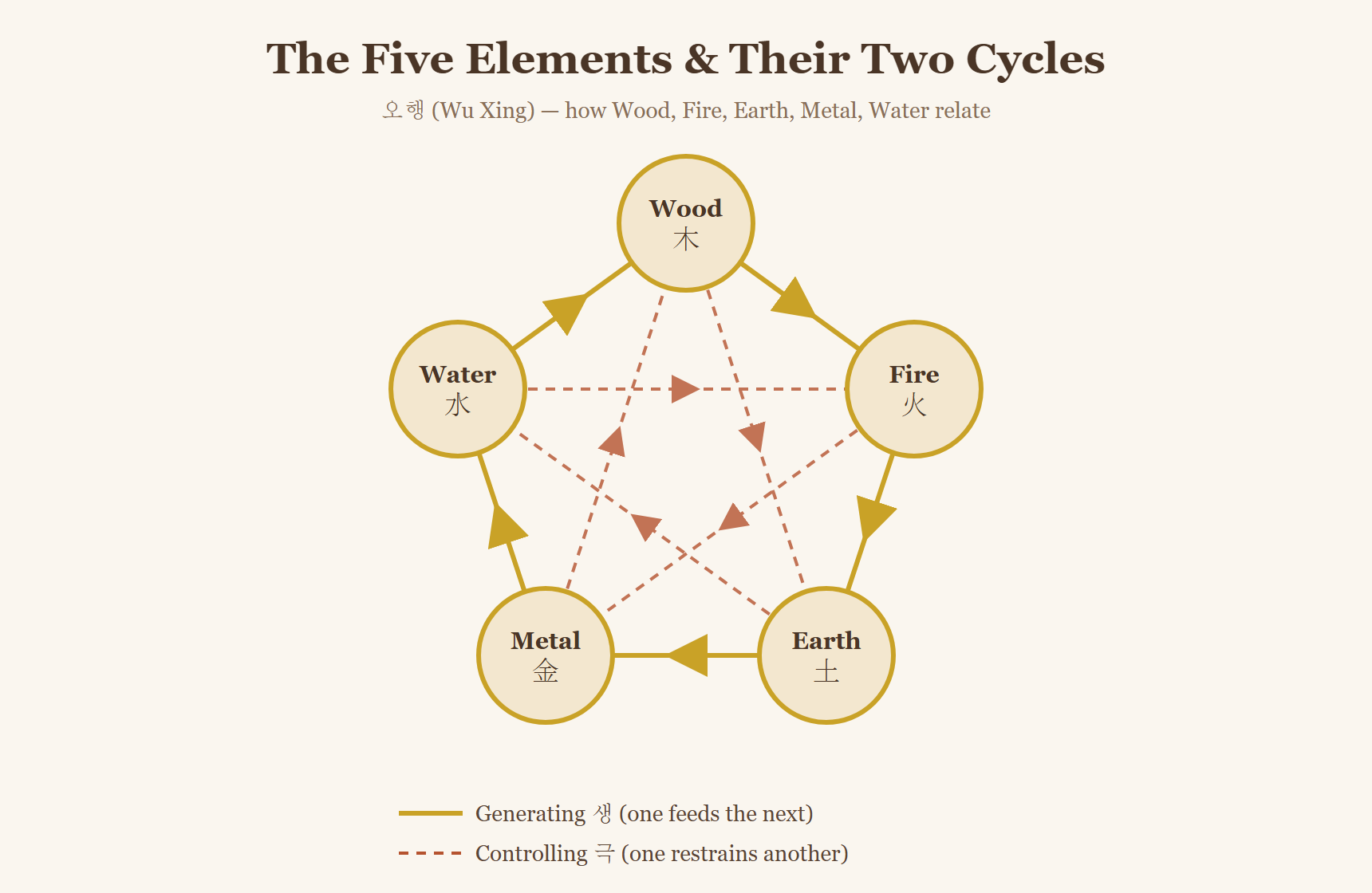
The Five Elements in Saju (오행, oheng in Korean; 五行, Wu Xing in Chinese) are Wood, Fire, Earth, Metal, and Water—five kinds of energy that everything, including a person, is made of. In a Saju chart they interact through two great cycles: a generating cycle (생, saeng), where each element nourishes the next, and a controlling cycle (극, geuk), where each element restrains another. Reading a chart means seeing which of these five energies are strong, weak, or absent, and how they push and pull on each other.
That's the whole idea in a nutshell. The rest of this guide unpacks each element's character, lays out both cycles side by side, and shows how practitioners read elemental balance—without ever treating any of it as fixed fate.
What the Five Elements Actually Are
Think of the five elements less as physical "stuff" and more as five flavors of movement. The ancient observers who shaped this system watched the seasons turn and named what they saw: things rising, peaking, settling, contracting, and flowing. Each element is a snapshot of one of those phases.
Here is the quick character sketch of each:
- Wood (목, 木) — growth, expansion, vision. The energy of a sapling pushing upward in spring. Wood people often read as forward-looking, idealistic, and eager to begin things.
- Fire (화, 火) — heat, light, expression, connection. The peak of summer. Fire tends toward warmth, visibility, passion, and a love of being seen.
- Earth (토, 土) — stability, nourishment, mediation. The settled center between seasons. Earth leans toward reliability, patience, and caring for others.
- Metal (금, 金) — structure, clarity, refinement, boundaries. The crispness of autumn. Metal favors precision, principle, and cutting away what isn't needed.
- Water (수, 水) — depth, wisdom, adaptability, flow. The stillness of winter. Water suggests reflection, intuition, and the ability to move around obstacles.
These are tendencies, not labels. Almost everyone carries a mix of all five in some proportion, and the interesting part of a chart is the blend.
The Two Cycles That Run Everything
The five elements never sit still. They constantly feed and check one another through two relationships. Understanding both is the heart of reading a Saju chart.
The Generating Cycle (생 / productive)
In the generating cycle, each element creates or nourishes the next, like a parent supporting a child. Energy flows forward:
| Element | feeds / produces | Next element |
|---|---|---|
| Wood | fuels | Fire |
| Fire | leaves behind ash, becoming | Earth |
| Earth | bears ore, yielding | Metal |
| Metal | collects and carries | Water |
| Water | nourishes | Wood |
Then it loops: Water nourishes Wood, and the whole circle begins again. The logic is intuitive once you picture it—wood burns to make fire, fire's ash settles into earth, earth's veins hold metal, cool metal gathers dew and water, and water lets new wood grow.
The Controlling Cycle (극 / restraining)
The controlling cycle is how the elements keep each other in check, so no single energy runs away unchecked. Here each element restrains the one across from it:
| Element | restrains / acts on | Target element |
|---|---|---|
| Wood | parts and depletes | Earth |
| Earth | dams and absorbs | Water |
| Water | quenches | Fire |
| Fire | melts | Metal |
| Metal | chops | Wood |
This loop also repeats. Roots break up soil, soil banks a river, water puts out fire, fire softens metal, and an axe cuts wood. Control isn't "bad"—it's balance. A chart full of unchecked Fire, for example, may actually want some Water to cool it.
The two cycles work together. Generation keeps energy flowing; control keeps it from overflowing. A healthy chart usually has both happening among its elements.
Curious where your own energies sit? Map your personal element balance with a free Saju chart at SajuClarity—it takes about a minute and shows all five at a glance.
How Elements Show Up in a Chart
A Saju chart has eight characters—four pairs across four "pillars" (year, month, day, hour). Each of those eight characters carries an element, so your chart is really a small ecosystem of the five energies.
These characters come from two sets:
- The 10 Heavenly Stems (천간, 天干) — each element appears in a Yang and a Yin form. For example, 甲 (Yang Wood) is a tall tree; 乙 (Yin Wood) is a vine or grass. 丙 is Yang Fire (the sun), 癸 is Yin Water (a gentle mist), and so on through all five elements.
- The 12 Earthly Branches (지지, 地支) — the familiar zodiac animals (rat, ox, tiger…). Each animal also carries an element, adding more texture to the chart.
Reading from the Day Master
Here's the piece beginners most often miss: balance is never judged in the abstract. It is always read relative to the Day Master (일간, il-gan)—the Heavenly Stem of your day pillar, which represents the core "you."
So if your Day Master is Yin Water, the practitioner asks: what supports this Water (Metal, which produces it)? What drains it (the Wood it feeds)? What controls it (the Earth that dams it)? What does it control (the Fire it quenches)? The same element can be a source of strength in one chart and a source of pressure in another, depending on whose chart it is.
Strong, Weak, and "Missing" Elements
When practitioners say an element is strong, they mean the chart has a lot of it or strong support for it. Weak means little support, and missing means it doesn't appear among the eight characters at all.
A missing element is not a flaw or a curse. It often simply points to a quality you reach for, develop deliberately, or attract through people and environments. Someone with no Water in their chart isn't doomed to be unwise—they may just cultivate reflection consciously rather than by default. Saju describes tendencies and themes, never a locked outcome. You always have room to shape how these energies express.
A Few Quick Examples of Balance
To make it concrete:
- A chart heavy in Wood and Fire often reads as energetic, expressive, and quick to start—possibly benefiting from a little Metal (structure) or Water (rest) to steady it.
- A chart strong in Earth and Metal may be grounded and disciplined, sometimes warmed by a touch of Fire or loosened by Wood's growth.
- A chart where one element is overwhelmingly dominant isn't "better"—balance and flow usually matter more than sheer quantity of any single energy.
The art of Saju is reading these proportions in context, always anchored to the Day Master.
Frequently Asked Questions
Q: What are the five elements in Saju? A: They are Wood (목 木), Fire (화 火), Earth (토 土), Metal (금 金), and Water (수 水)—five types of energy, called oheng in Korean and Wu Xing in Chinese. Every character in a Saju chart carries one of them.
Q: What's the difference between the generating and controlling cycles? A: The generating cycle is supportive—Wood feeds Fire, Fire makes Earth, Earth bears Metal, Metal carries Water, Water nourishes Wood. The controlling cycle is restraining—Wood depletes Earth, Earth dams Water, Water quenches Fire, Fire melts Metal, Metal chops Wood. Generation keeps energy flowing; control keeps it balanced.
Q: Is it bad to be missing an element in my chart? A: No. A missing element is not a curse or a defect. It usually points to a quality you develop intentionally or draw in through relationships and environment. Saju describes tendencies, not fixed fate, so there's always room to grow into a missing energy.
Where to Go Next
Once you see your own eight characters, the five elements stop being abstract and start describing patterns you'll recognize in yourself. The easiest first step is to generate your chart and look at the spread.
See your own Five Elements balance — free chart at SajuClarity
See it in your own chart
Start free — build your Saju chart in seconds. Ready for the full picture? The complete 15-chapter reading interprets all of it: who you are, how you love and work, and the years ahead.